
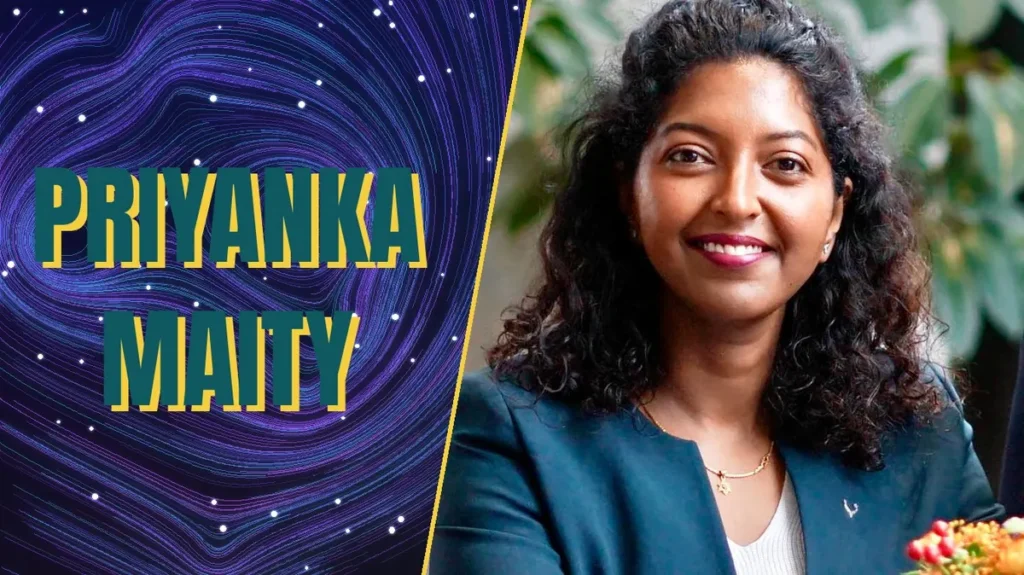
Light and air are invisible – yet they may hold the key to a chemical-free future. Where others simply breathe, Dr. Priyanka Maity sees vectors, vortices, and equations. The physicist has conducted research at IIT, TIFR, and TU Ilmenau; today she simulates flows for Hoenle UV Disinfection GmbH. In this interview, she explains how UV light fights germs without chemicals, why her gut feeling beats every perfect simulation – and how AI is changing her work.
DEDieses Interview auf Deutsch lesen →
From Turbulence to UV Lamps: You’ve conducted research at elite institutions like the IITs, TIFR, and TU Ilmenau. What was the biggest “culture shock” when moving from pure theory to the production halls of Hoenle UV Disinfection GmbH?
Well, it depends on the customers and people you are dealing with. When you are in academia and giving presentations, the audience usually comes from your own field or at least has a technical background. In industry, the audience can include people from both technical and non-technical backgrounds. The stark difference from academia is that people in industry, especially those without a technical background, are not really interested in the science behind what you are developing. They look at it from a problem-and-solution perspective and are usually not interested in the intermediate steps. You have to meet a deadline and show results. The physics behind it is not important for most.
Also, in academia we usually study idealized systems. When I moved to industry, the physics became much more complex and realistic. To account for it and simulate it, we need to adapt our academic training and embrace how industry works.
The Matrix Perspective: You calculate complex flows (CFD). When you walk through a busy street, do you see vectors, vortices, and mathematical formulas swirling around everyone?
Well, not really, because busy streets are modelled by other physical equations – that’s more of a problem for people working in swarm dynamics. But jokes apart, yes, sometimes I do try to spot vortical structures in cloud formations in the sky or in water flowing in a river, and visualize my simulations then and there to find the overlap.
For instance, I once started explaining the Kelvin-Helmholtz instability to a friend while we were standing on a bridge in Bamberg, staring down at the water flowing past the bridge’s columns. After that, my friend never accompanied me near a body of water ever again. (laughs)
The “Eureka” Moment: In academia, success is often a paper publication. How does it feel to create a simulation and then hold a physical product in your hands that works exactly as the computer predicted?
People in industry can publish papers or file patents, too. But for me, when you develop a product and launch it on the market with the help of your simulations, that brings twice the satisfaction. It validates your work and gives you a sense of real achievement.
Academia is futuristic, and industrial research is more realistic. The knowledge from the papers you publish today may reach the commercial market in five or ten years. But the development work you do in industry today will be out there in one or two years.
UV Disinfection Without Chemicals: How the Technology Works
UV Light for Dummies: Most people only know UV light as the cause of sunburn. If you had to explain your work to a five-year-old: what kind of “superhero gadget” are you actually building?
For a five-year-old, it has to be in the simplest words. I would probably tell them that UV rays are a part of sunlight that our eyes cannot see, but in the right amounts they can help kill germs and bacteria. If you are exposed to too much of them, though, you get sunburned. For an adult who is new to the topic, other aspects could be explained as well.
Taming Chaos: Turbulence is one of the greatest mysteries in physics. Do you sometimes feel like a “lion tamer” trying to teach manners to the chaos of air and light?
To be honest, I feel more like a humbled kid scolded by Mother Nature. Whenever my simulations do not run or show an error, I feel how tiny human knowledge is compared to the complexity of the physics of the universe. It is a humongous task for humans to match all the complexities of nature, but it seems AI can finally tame the lion.
Things have changed since OpenAI solved the Millennium Prize problem on turbulence*. When you employ AI, it is a completely different story altogether. You feel more like a teenager than a child now.
Chemical-Free Sustainability: UV light can disinfect and cure without any harsh chemicals. Are you essentially an “environmental scientist in a lab coat,” cleaning the world with photons instead of poison?
I truly like your interpretation – maybe next time I will use it in another interview. I do work along similar lines, but without the lab coat. The goal is to develop chemical-free disinfection technology that is more effective and also energy-efficient. UV technology is indeed more effective in disinfection because it deactivates even drug-resistant microorganisms by damaging their DNA or RNA.
The bottleneck is that one of the sources of UV light are mercury lamps, which are not very environmentally friendly, and UVC LEDs are still in the early stages of development with low efficiency. Therefore, UVC LEDs are not yet very cost-effective.
But apart from disinfection, UVC technology can also be used to modify polymer bonds, which makes it useful in the curing and recycling industries. More detailed research is needed in these fields, though.
Man, Machine, and Intuition
Trust Is Good, Physics Is Better: If the computer spits out a perfect simulation, but your gut feeling says “this can’t be right” – who wins that internal battle?
I will go with my gut feeling. If a simulation spits out perfect results, I know something must have gone wrong. As the old saying goes, nothing is perfect, and that applies to simulations as well. Simulations usually rely on many approximations, and they differ from experiments or real-life situations by some percentage.
I have faced this situation many times, and my gut feeling always wins. You have to compare your simulations with known results to see whether they are working.
The Aesthetics of the Vortex: Your simulations often look like vibrant modern art. Do you have a framed plot of a particularly beautiful turbulence hanging over your sofa at home?
They do look picturesque. The vortices are already there in Van Gogh’s “Starry Night.” But yes, it is my secret wish to create a picture from simulations someday – maybe one good enough to hang in the living room.
AI vs. Human Brain: We talk a lot about AI today. Can it ever replace the intuition of an experienced CFD engineer, or do “noteworthy” innovations still require a human mind?
This is the hot topic everyone is debating today. Currently, it still requires some human supervision, depending on the task. But given the rapid pace at which AI is progressing, it may happen someday.
From India to Ilmenau
From India to Ilmenau: Physics is a universal language, but coffee cultures differ. What do you miss most about the Indian research world, and what do you appreciate most about German engineering?
The research world is more or less alike across countries and cultures. I do not really miss much about the Indian research culture. I appreciate the work-life balance in German research much more. The competition in India is cut-throat, people are ambitious, and you are expected to work even on weekends.
Here it is much more relaxed. You work efficiently in less time, and I really find this more productive. German research also relies more on industrial partnerships, so you can see your results turn into real-world applications sooner. This is something India needs to catch up on: more collaboration between academia and industry.
The Crystal Ball: Looking five years ahead, which “nasty” problem (like specific germs or pollutants) will be history thanks to your UV simulations?
Maybe not only my simulations, but the collective efforts of everyone working in UV technology can really help fight the next pandemic. Likewise, UV technology could massively revolutionize the recycling industry, as it may help process microplastics in bodies of water. But to be certain, we still need a lot of research in this field.
The “Noteworthy” Advice: What is your tip for young physics students who want to change the world but are intimidated by the “dry” mathematics?
Firstly, to me mathematics is not dry at all. It is in fact interesting and is considered the language of physics. My advice to everyone would be: just try it out without any preconceived notions. Most things look scary until you try them. It is just like swimming – you must get into the water to start learning in the first place. So try it out and explore the world. It will open up a plethora of opportunities and interests.
Dr. Priyanka Maity is a physicist and R&D engineer at Hoenle UV Disinfection GmbH, where she supports the development of UV technologies with flow and thermal simulations. She holds a Ph.D. in computational fluid dynamics from IIT Kharagpur and a master’s degree in physics from IIT Madras, and conducted postdoctoral research on turbulent flows and pattern formation at ICTS-TIFR in India and TU Ilmenau. Priyanka Maity on LinkedIn
This interview is also available in German.
Interview: Thomas Jan Krajniewski
Published on beachtenswert.org on 02/11/2026

Tom is the chief wordsmith at beachtenswert.org and welcomes feedback with open arms. He’s been crafting stories since 2012, dabbles in book authoring, and has a profound love for meandering around the globe (emphasis on ‘meandering’).